Case study · In progress · November 2026
Proformas, personal receipts and the IVA return
A pilot with House Renovation Sóller, a renovation firm in Mallorca. This page is updated as the pilot runs.

- The firm: a British-owned renovation company registered in Spain, with one person doing all the admin and a gestoría filing the quarterly IVA return.
- The problem: suppliers send proformas, the firm pays them, and the real factura often never arrives, so the IVA can't be claimed until someone chases it. Receipts also arrive mixed with personal ones and get sorted by hand.
- What we're building: a Google Sheet in the firm's own Google account. AI reads each document, written rules check it, and a Monday email lists what's missing with a message ready to send each supplier.
- Where it stands: a working demo on 50 made-up documents. Next is a test on the firm's last quarter against what the gestoría filed. The first real quarterly pack is due in January 2027.
How it started
The firm took the free AI diagnostic on this site. It ranked IVA returns first and supplier invoices second, said both were annoying and took time, and named accuracy and who sees the data as its main concerns about AI. A short exchange afterwards narrowed the problem down to two things.
The problem
Proformas. Many building suppliers send a proforma, the firm pays it, and the final factura comes late or not at all. A proforma isn't a valid invoice for IVA, so on a 2,000 € proforma the firm can't claim the 420 € of IVA until the real factura arrives. Keeping track of which proformas are still open, across dozens of suppliers, is the part that eats the time.
Sorting. The firm uses an invoice capture app that finds every receipt and invoice in the inbox and saves them to the gestoría's Google Drive. It finds the cement and the easyJet flight alike, so someone still goes through the lot to pull out the business costs.
Both problems land at quarter end, when the gestoría needs a complete set of facturas for the return.
What we're building
The solution sits inside a Google Sheet in the firm's own Google account, with a small custom program behind it (a Google Apps Script). The program adds a Facturas menu to the sheet, next to Help, so there's no new software to install or learn. Each part of the work goes to whatever does it best.
| Who does it | What it does |
|---|---|
| AI (Gemini, processed in the EU) | Reads each PDF or photo: supplier, NIF, date, amounts and IVA. Says whether it's a factura, a proforma or a ticket, and whether it looks like a business or a personal cost. |
| Written rules | Check the IVA maths and rate, missing or invalid NIFs, duplicates, tickets without the company's NIF, subcontractor invoices that should show inversión del sujeto pasivo, and which proformas still have no factura. |
| The program | Matches bank payments to facturas, sends a Monday email with what's missing and a message in Spanish for each supplier, and builds the quarter pack with a draft email to the gestoría. |
| A person | Confirms anything flagged as possibly personal, checks the pack and presses Send. Nothing reaches the gestoría without that check. |
The AI never decides anything about tax. It turns documents into fields, and the rules make every call, so each flag can be traced to a line of code. That matches what ScalePoint Research finds when it tests models on finance work: models read well, and rules and people should own the decisions.
What the firm sees
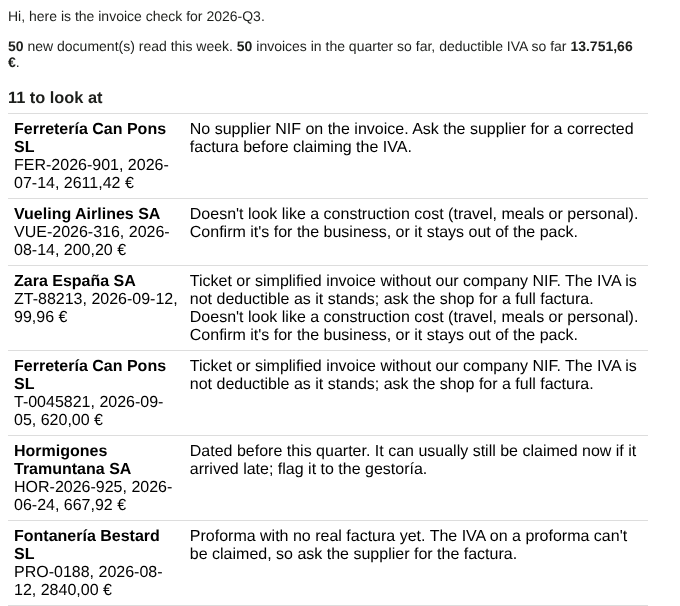
Every Monday, one email lists what needs a look, with the reason in plain words. This is the top of the email from the made-up quarter, where the documents belong to an invented building firm.
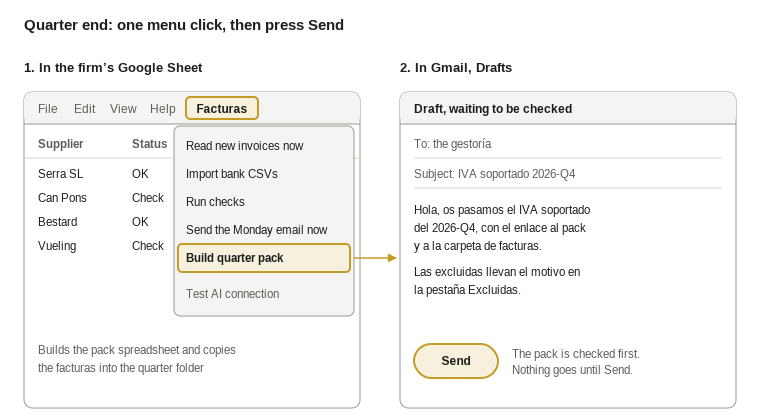
At quarter end, one click in the sheet's Facturas menu builds the pack and leaves a draft email to the gestoría in Gmail. Nothing is sent until the firm has checked the pack and pressed Send.
Data and cost
The documents stay where the capture app puts them, and the sheet only reads them. The sheet and the AI account sit in the firm's own Google account. Google doesn't use Vertex AI customer data to train its models. Before any real document goes through, data caching is switched off and an exception from Google's abuse monitoring is requested, so Google doesn't keep copies after reading.
At list prices, the AI reading costs about a euro a quarter at this firm's volume. The test on last quarter will give the real figure per document.
How it's being tested
Before touching real documents, we built a made-up quarter: 50 documents for an invented building firm, with 11 problems planted in them. They include two proformas with no factura, a flight and a clothes receipt, a duplicate, a missing NIF, wrong IVA maths and a subcontractor charging IVA where reverse charge may apply. With the documents read correctly, the rules flag all 11 and nothing else, and they spot the two bank payments made with no factura.
That tests the rules. The open question is how well the AI reads real documents, which is what the next step measures.
The plan
| Step | What happens | Status |
|---|---|---|
| 1. Demo | The tool running on the made-up quarter, shown to the firm | In progress |
| 2. Set up | Copied into the firm's Google account and pointed at its documents | Next |
| 3. Test on last quarter | Real documents compared with the IVA figures the gestoría filed | Planned |
| 4. Live alongside | A week running next to the firm's usual way, with the first Monday email | Planned |
| 5. Decide | The firm decides whether to keep it, change it or stop | Planned |
Coming next
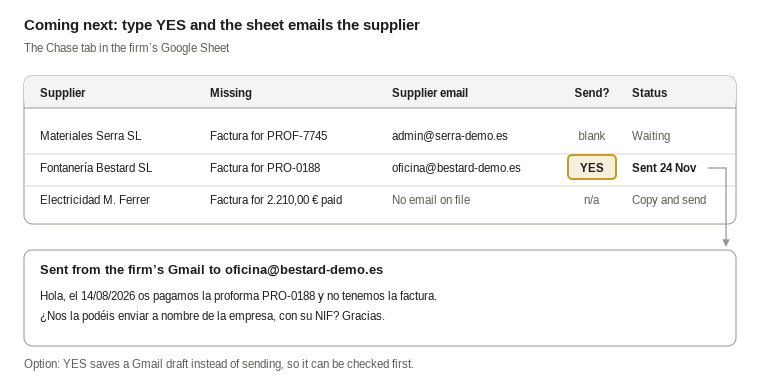
Today the Monday email gives a message in Spanish to copy and send. The next step, once the pilot is running, is to send it from the sheet: the firm types YES next to a supplier in the Chase tab and the sheet emails that supplier from the firm's Gmail, or saves a draft to check first. A line with no supplier email stays as copy and send.
Results
This section fills in as the pilot runs: how often the AI read each field correctly on real documents, how many open proformas it found, how many personal receipts it caught, the cost per document, and the first real quarterly pack in January 2027.
On the process map
The pilot covers four processes on the process map, all in cluster C11, payables, receivables and close: supplier invoices, proforma tracking, expense checks and VAT return preparation.
Last updated 24 November 2026. Published with the firm's agreement.