Case study · Demo · November 2026
Onboarding emails and KYC reviews: an AI assistant in the team’s inbox
A working demo we built for Northbank FX, a fictional UK FX and payments firm, run on 20 made-up cases. It isn’t a client project. Every company, person and figure on this page is made up.
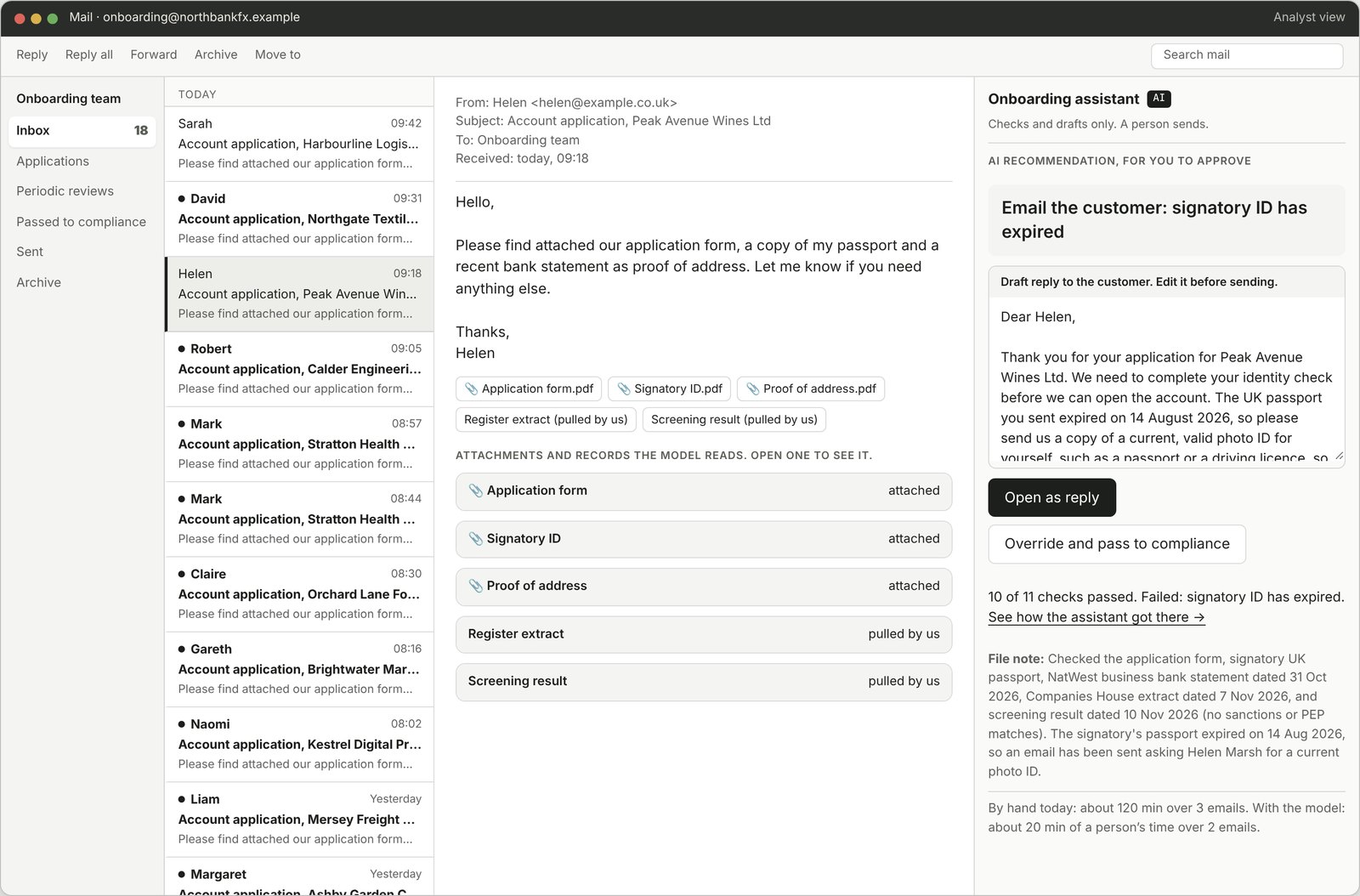
- The firm: Northbank FX, a fictional UK FX and payments firm with about 7,000 business customers. It onboards new customers by email and runs periodic KYC reviews by hand.
- The problem: customers rarely send everything right first time. An analyst reads every document, checks it against Companies House and the screening result, and writes each chaser, so an application takes about three rounds of email and two hours of staff time.
- What we built: an assistant that sits in the team’s mailbox as an add-in. It reads the email and attachments, checks them against the register and screening, and drafts the reply. The team’s inbox and steps stay the same.
- How the AI is used: two model calls per case, one to read the documents and one to draft the reply. Code does the exact checks and picks the next step from fixed rules. A person sends every email and makes every decision.
- Where it stands: a working demo, with ten models recorded on the 20 cases on 17 November 2026. The next step for a real firm would be testing on its own anonymised past cases.
What the assistant does
An analyst opens an application email as usual. The assistant panel next to it shows a recommendation (approve, email the customer, or pass to compliance) and, where the customer needs to send something, a draft reply. The analyst opens the draft as a reply, edits it if needed and presses Send. Outlook and Gmail both support add-ins that show a panel like this next to an email.
| Who does it | What it does |
|---|---|
| AI model, call 1 | Reads the application form, ID, proof of address, register extract and screening result, and puts each detail in a named field. Answers the four checks that need judgement, such as whether “Ltd” and “Limited” are the same company name, or whether a board resolution authorises the signatory. |
| Code | Runs the seven exact checks: company number, company status, strike-off, ID expiry, proof of address date, politically exposed persons and high-risk countries. Then picks the next step from three fixed rules that compliance signs off. |
| AI model, call 2 | Writes the email to the customer and the file note from the failed checks. It can’t change the decision. |
| A person | Reads the recommendation, edits and sends the email, and makes the final decision. Anything that needs a risk decision goes to compliance. |
The demo’s How it works tab shows every step for each of the 20 cases, the rules in full and the instructions sent to the model. This split follows what ScalePoint Research has found testing AI models on finance work: models read well, and rules and people should own the decisions.
The business case
We compared three ways to run onboarding and reviews over three years: carry on as today, add the assistant to the current process, or move to a KYB onboarding platform. The volumes and staff times are illustrative assumptions for a firm of about £100m revenue, and a real firm would replace them with its own.
| Today | AI on the current process | KYB platform | |
|---|---|---|---|
| Staff hours a month, once live | 1,033 | 308 | 330 |
| People’s worth of hours | 7.5 | 2.2 | 2.4 |
| Months to go live | – | 3 | 4 |
| Staff cost over 3 years | £1,240,000 | £442,000 | £490,000 |
| Technology cost over 3 years | – | £160,000 | £388,000 |
| Total over 3 years | £1,240,000 | £602,000 | £878,000 |
| Saving against today | – | about £640,000 | about £360,000 |
Almost all of the saving comes from staff time. We assumed an application takes three rounds of email at 40 minutes each today, and two rounds at 10 minutes each with the assistant, because it asks for everything missing in one email and the analyst only checks and edits the draft. Reviews where nothing has changed close with no email at all. On those numbers the same work needs about 2.2 people’s worth of hours instead of 7.5. For a growing firm, that means the team can take on more customers without adding headcount, and analysts spend their time on the cases that need judgement.
The model itself is a small part of the cost. At 400 applications and about 230 reviews a month, the model costs from about £23 over three years with gpt-oss-120b to about £1,400 with Claude Opus 5.5, under 1% of the AI route’s total. Even if scanned documents, retries and longer prompts pushed it to 80p a case, the model would come to under 3% of the total. The build at about £60,000 and running and support at about £36,000 a year matter far more.
Other assumptions: 15% of cases go to compliance and are worked fully by hand on every route, a fully loaded analyst costs £55,000 a year, and 40% of customers are reviewed each year. The demo’s cost model is available on request.
Would a KYB platform be better?
A KYB platform gives customers a portal to upload documents and runs automatic register, ID and sanctions checks, with ongoing monitoring that flags changes at the company. On our assumptions it saves a lot against today, and it beats carrying on by hand at volumes as low as about 120 applications a month.
It doesn’t beat the assistant at any volume on these numbers, because it saves slightly less staff time per case and costs more to run, at about £12 of checks per case plus a platform fee. It also changes how customers send their documents, which is the step this firm chose not to change. A firm that needs ongoing monitoring, or one client record across many countries, could still be better off with a platform, and the two can work together.
Does the choice of model matter?
We ran the same 20 cases through ten models and recorded every result. The table shows how often each model reached the right decision, how often it made the costly error, and what the reading and checking step cost.
| Model | Right decision | Missed a request or referral | Cost to read and check 1,000 cases |
|---|---|---|---|
| Claude Opus 5.5 | 20 of 20 | 0 | £18.60 |
| GPT-5.5 | 20 of 20 | 0 | £17.40 |
| Mistral Large 4 | 20 of 20 | 0 | £9.30 |
| Claude Haiku 5.5 | 20 of 20 | 0 | £0.70 |
| gpt-oss-120b (open weights) | 20 of 20 | 0 | £0.30 |
| Grok 4.3 | 19 of 20 | 0 | £3.10 |
| Mistral Large 3 (open weights) | 19 of 20 | 0 | £0.90 |
| DeepSeek V3.2 (open weights) | 19 of 20 | 0 | £0.30 |
| GPT-5.4 mini | 18 of 20 | 1 | £1.70 |
| Llama 4 Maverick (open weights) | 18 of 20 | 1 | £0.40 |
Five models got every case right, and two of them cost under £1 per 1,000 cases. The costly error is approving a case that needed a document or a compliance decision. GPT-5.4 mini and Llama 4 Maverick both approved an application where the signatory wasn’t a director and had no board authority. Five models emailed a customer on a review where nothing had changed, which wastes a customer’s time but lets nothing through.
Hence the choice of model turns on the errors a firm can accept, and on what a vendor charges compared with what the model costs. Twenty cases are enough for a demo. A firm would run the shortlisted models on a few hundred of its own past cases before picking one. Our research shows bigger gaps between models on harder tasks such as reconciliation.
How it would run
In production the assistant runs inside the firm’s own cloud account, on Microsoft Azure, AWS, Google Cloud or a European cloud. Nine of the ten models in the table are confirmed on Azure, and Mistral Large 4 is still to be confirmed. The add-in can only read the open email and create drafts and file notes. It can’t send email, approve an account or change a customer record. Every input, model answer, rule result and human decision is logged in the firm’s own account for audit.
How a firm would take it forward
We’d start with a two-hour workshop with operations, compliance and IT to pick the process to start with. A short diagnostic then measures the real volumes, email rounds and staff minutes, so the business case rests on the firm’s own numbers. Next we test the shortlisted models on anonymised past cases inside the firm’s cloud account, then run a pilot on one process alongside the team, with a person approving every email. The firm can stop after any of these steps.
On the process map
The demo covers two processes on our process map: business customer KYB and periodic KYC review.
Last updated 27 November 2026. Northbank FX, the people and the cases are fictional; the model results come from one recorded run on 17 November 2026.