Agentic AI in Finance: Why Maturity Comes Before Machines
Agentic AI in fintech finance only delivers value when the CFO office progresses through a maturity path

In Brief
Agentic finance is not an AI project, it is the outcome of disciplined data maturity built over time.
The Data Maturity Pathway clarifies where you actually are, not where the vendor narrative says you should be.
If your economics are not machine readable and structurally coherent, automation will only scale ambiguity.
In Detail
“Agentic AI” is already drifting towards cliché. It turns up in conference agendas and investor decks promising a finance function that runs itself. If you are actually leading a strategic finance team inside a fintech, that probably feels detached from reality. Month end still requires choreography. Data still arrives late and in inconsistent formats. Forecasts still depend on manual intervention that nobody would design from scratch. So before we get carried away, it is worth asking what this really means in practice.
At its core, the shift is from tools that follow rules to systems that pursue goals within guardrails. Traditional automation executes predefined steps and breaks when the inputs change. Agentic systems are designed to interpret context, apply judgement and act within defined boundaries. In finance terms, that might mean reading an unstructured invoice, understanding its economic category, checking it against budget and triggering the appropriate approval workflow without being told exactly where every field sits. That is a meaningful step forward.
The Uncomfortable Constraint
Here is the part that rarely makes the keynote slide. Systems that reason depend on coherent data and explicit processes. They require consistent definitions of revenue, cost and margin. They require clarity about authority, thresholds and escalation. If your chart of accounts has evolved through product pivots and your data sits across partially aligned systems, cognitive automation will not resolve that tension. It will surface it. The conversation about Agentic AI is therefore less about technology and more about operational discipline. The finance teams that will benefit first are those that already understand their own economic logic and have embedded it into systems.
A More Honest Maturity Path
It is more useful to think in stages rather than headlines. Most fintech finance functions sit somewhere between manual and partially integrated. A smaller number have embedded rules-based automation. Fewer still have moved into augmented, model-driven decision support. Genuine agentic capability remains rare. The table below sets out what those stages look like in practice, how they feel inside the team, and what actually moves you forward.
What matters is not just where you sit, but how steep the climb becomes at each transition. Moving from manual to integrated is largely operational effort. Moving from rules-based automation to augmented intelligence demands structural coherence and trust in data. Moving from augmentation to genuine agentic capability introduces governance and accountability questions that are not merely technical. The curve steepens.
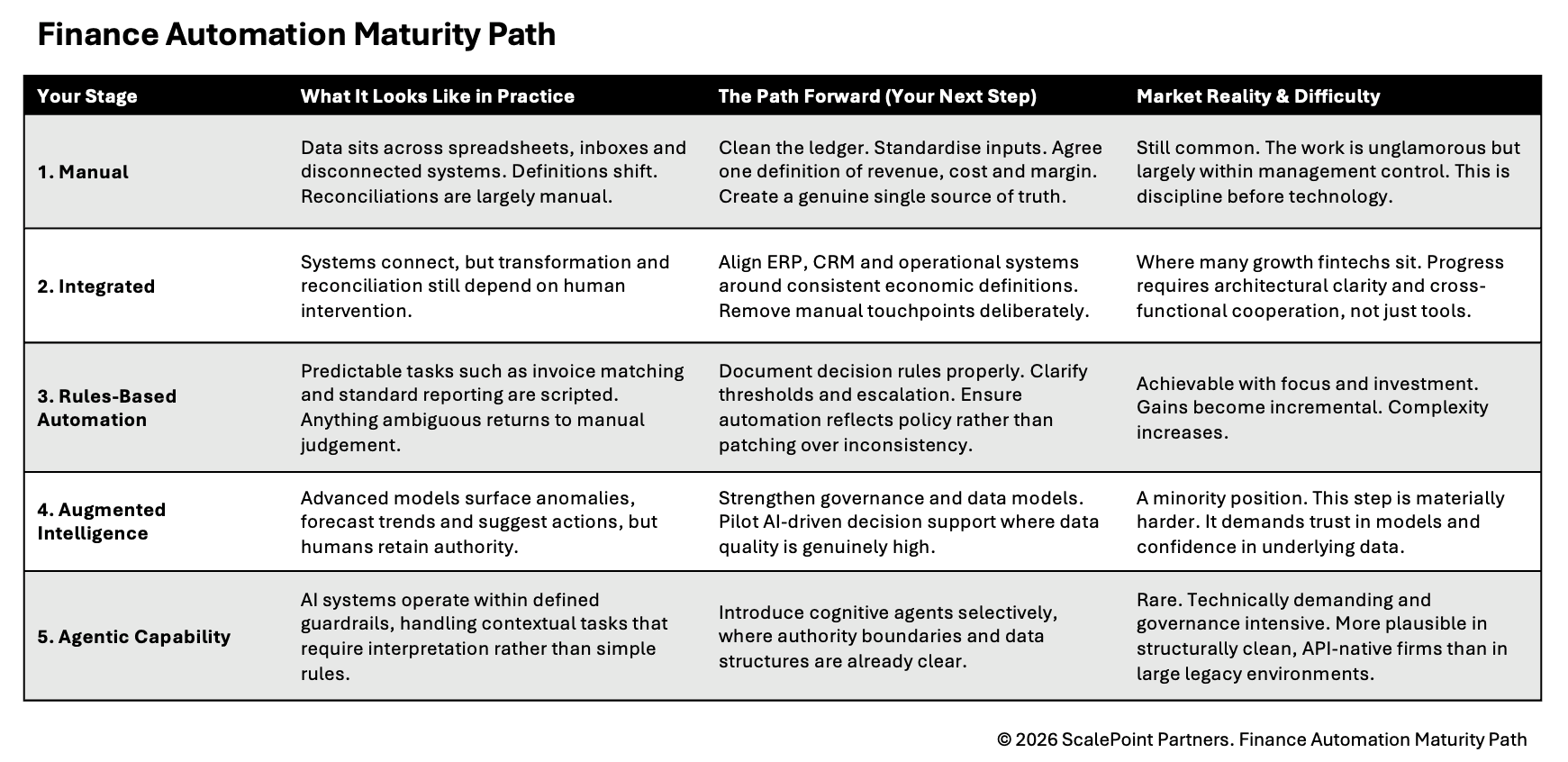
The important point is that stage five rests on the earlier stages being done properly. Agentic capability is not the next upgrade after scripting workflows, nor is it a shortcut around messy data or ambiguous processes. It is the consequence of having already embedded data discipline, architectural clarity and model-driven decision support. Without that intermediate maturity, autonomy is fragile. Properly earned, however, it becomes an accelerator once clarity already exists. For strategic finance teams, the prize is not novelty but focus. If cognitive automation removes the mechanical burden of assembling numbers, it creates space for the work that actually shapes valuation and resilience: capital allocation, risk management, pricing discipline and unit economics. But that outcome depends on groundwork.
If you are serious about preparing the CFO office for what comes next, the question is not whether you have an AI strategy. It is whether your data model, system architecture and governance are robust enough to deserve one.